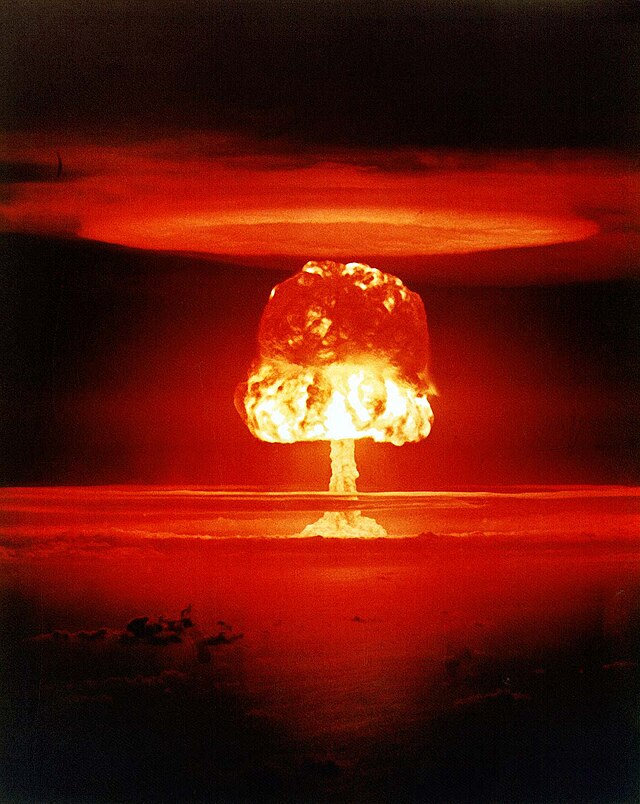
Target Age Group: 14–15 years old (Year 10 / GCSE) Time Required: 45–50 minutes Subject Links: History, English, Art & Design, PSHE, Philosophy & Ethics
Image Information
Subject: Castle Romeo nuclear weapons test
Date: 27 March 1954
Location: Bikini Atoll, Marshall Islands, Pacific Ocean
Yield: 11 megatons (approximately 730 times more powerful than the bomb dropped on Hiroshima)
Context: This was the first nuclear device detonated from a barge, positioned within the crater left by the Castle Bravo test conducted three weeks earlier. The Castle series was part of the United States’ thermonuclear weapons development programme during the Cold War.
Image source: United States Department of Energy (public domain)
Learning Objectives
Students will explore how images can provoke complex and contradictory emotional responses, understand why we might feel drawn to images of destruction, and examine how official photography of nuclear tests was designed to communicate power.
Theoretical Framework (Simplified)
This exercise introduces students to two connected ideas:
Affect: The immediate, bodily feelings an image produces in us—before we consciously process what we’re seeing. The gut reaction, the intake of breath, the feeling in the chest.
The Sublime: A concept from philosophy describing experiences that are both terrifying and awe-inspiring—things so vast, powerful, or overwhelming that they exceed our ability to comprehend them. Mountains, storms, the ocean, and catastrophic destruction have all been described as sublime.
The nuclear mushroom cloud presents a particular problem: it is visually spectacular, perhaps even beautiful, while being a tool of mass death. This exercise asks students to sit with that uncomfortable contradiction.
Stage 1: Individual Response (12 minutes)
Feeling Before Thinking
Students examine the image in silence for two full minutes. No writing, no discussion—just looking.
Then respond in writing:
Body Check:
- Where in your body do you feel something when you look at this image? (Chest, stomach, throat, shoulders, nowhere specific?)
- Describe that physical sensation in a few words.
Emotional Inventory: Write down ALL the feelings this image produces—even contradictory ones. You might feel several things at once. Some possibilities to consider (but don’t limit yourself to these):
- Fear
- Awe
- Fascination
- Horror
- Excitement
- Dread
- Curiosity
- Admiration
- Disgust
- Wonder
The Uncomfortable Question:
Many people describe nuclear explosion photographs as “beautiful.”
- Do you find this image beautiful? Be honest – remember that there’s no wrong answer.
- If you do find it beautiful, how do you feel about finding it beautiful, given what it represents?
- If you don’t, what word would you use instead?
Stage 2: Image Analysis (15 minutes)
The Anatomy of Awe
Working in pairs, analyse the visual elements that shape your response.
Colour and Light:
- Describe the colour palette. What range of colours do you see from the centre outward?
- Where is the brightest point? Where is it darkest?
- How does the contrast between the intense light and the darkness affect how you feel looking at it?
Scale and Form:
- The mushroom cloud from this test reached approximately 40,000 feet (12 kilometres) high. How does the image communicate scale when there’s nothing familiar to compare it to?
- Describe the shape. The “mushroom cloud” has become one of the most recognisable images of the 20th century. Why do you think this particular form became so iconic?
- What does the spreading disc at the top look like? What other images or objects does it remind you of?
The Beauty Problem
The philosopher Edmund Burke wrote in 1757 that the sublime is “whatever is in any sort terrible… is a source of the sublime; that is, it is productive of the strongest emotion which the mind is capable of feeling.”
Discussion questions:
- This image shows the test of a weapon capable of killing millions. Why might humans be drawn to images of such destruction?
- What do you think the difference could be between finding something “beautiful” and finding it “sublime”?
Stage 3: World Connections (15 minutes)
The Context of Creation
Who made this image and why?
The US government documented nuclear tests extensively, creating thousands of photographs and films. This wasn’t accidental. The images served purposes:
- Scientific documentation
- Military records
- Demonstration of American power to domestic and international audiences
- Deterrence. These tests also showed potential enemies what the US could do
Discussion questions:
- How does knowing this is an official military photograph, not a news image or an artist’s work, change how you understand it?
- What is the image meant to make American citizens feel? What about citizens of other countries?
- The image was designed to inspire awe. Is there something manipulative about that?
Affect as Politics
Governments and militaries understand that images produce feelings, and feelings shape what people accept or reject.
Consider:
- If nuclear tests produced only disturbing, ugly images, might public opinion have turned against them sooner?
- How does the aestheticisation of weapons, by making them look impressive, powerful, even beautiful, affect how we think about war and military power?
- Where else do you see potentially harmful things made to look appealing or exciting?
Reflection Task (5 minutes)
Individual written response:
Choose ONE prompt:
- Explain in your own words why someone might feel both awe and horror looking at this image at the same time. What does that contradiction tell us about how humans respond to power and destruction?
- “This image is propaganda disguised as documentation.” Do you agree? Explain your reasoning.
- Write a short paragraph from the perspective of a Bikini Atoll islander seeing this photograph for the first time. What might they feel? What might they want viewers to understand?
Key Vocabulary
Affect: The immediate feeling or sensation produced by an experience, before conscious thought processes it.
The Sublime: An experience that combines terror and awe—something so powerful, vast, or overwhelming that it exceeds our understanding while also fascinating us.
Aestheticisation: The process of making something appear beautiful or artistically interesting, regardless of its actual nature or effects.
Deterrence: In Cold War terms, the strategy of preventing war by demonstrating the devastating consequences of attack.
 Teach Critically
Leave a comment