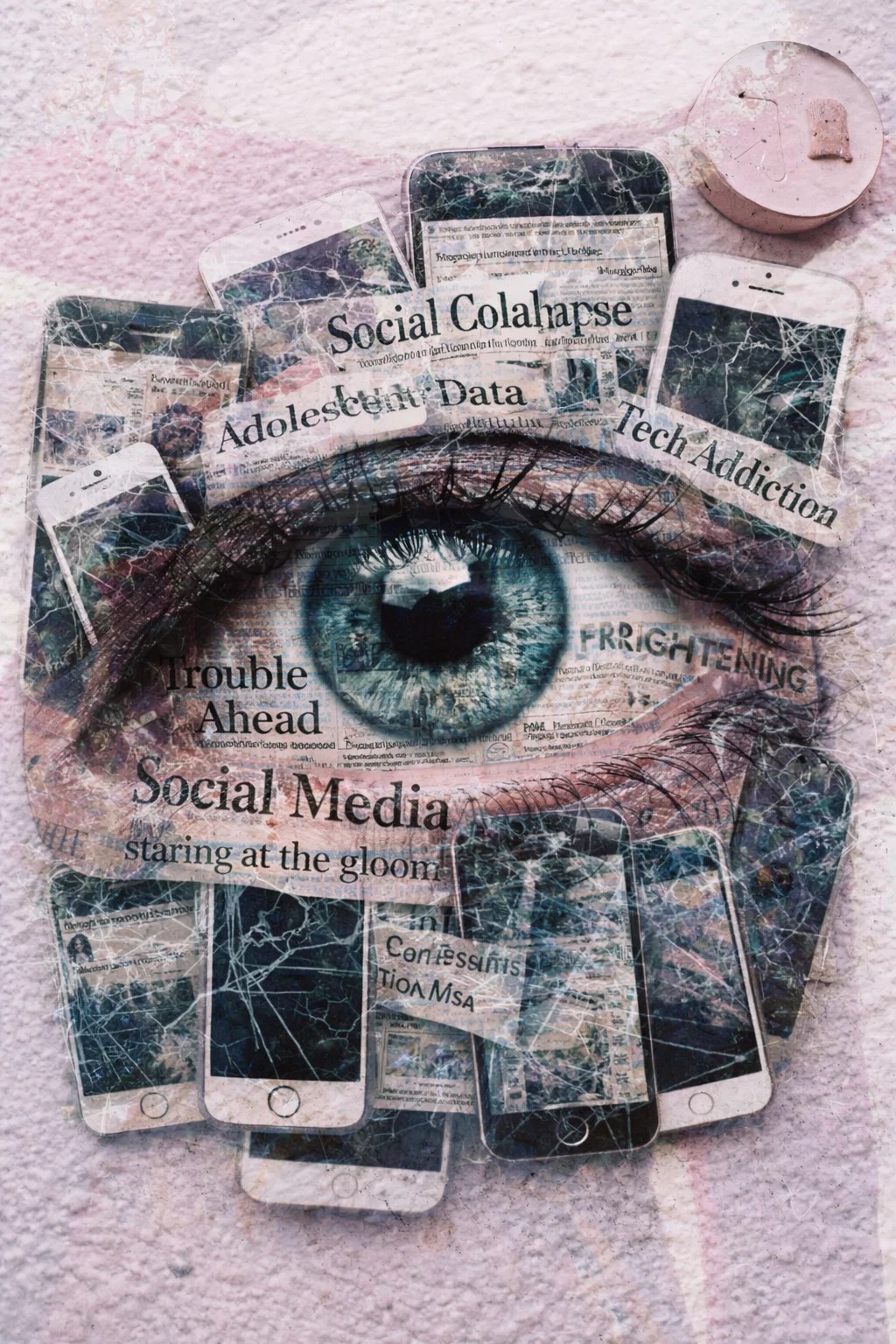
The Challenge We Face
Consider this: the average person now scrolls past thousands of images every day. Social media feeds, news websites, advertisements, AI-generated content… we are more steeped in visual information than ever before. Yet the uncomfortable truth is that we’re rarely taught how to critically engage with what we see.
The statistics are sobering. Only 18% of teenagers can correctly distinguish between news, advertisements, opinion, and entertainment. 59% of adults feel unable to identify misinformation online. And 73% of teachers feel unprepared to teach media literacy, with only 23% feeling confident to address digital literacy at all (Lindner, 2023).
This isn’t a minor educational gap. It’s a crisis.
The AI Slop Era
If the challenge was urgent in 2023, the acceleration and proliferation of artificial intelligence software have made it critical. We’re now living in what Merriam-Webster has dubbed the era of “slop” – their 2025 Word of the Year (Merriam-Webster, 2024), defined as low-quality digital content produced in mass-quantities by AI.
The numbers are staggering. Deepfake files are projected to reach 8 million in 2025, up from 500,000 just two years earlier (Ramirez, 2025). Europol estimates that 90% of online content may be synthetically generated by 2026 (European Parliament, 2025). Over 20% of videos that YouTube’s algorithm shows new users are now AI-generated content—collectively generating 63 billion views (Kirkland, 2025).
Here’s what makes this particularly troubling: while 60% of people believe they can spot a deepfake, controlled studies show human accuracy at identifying high-quality AI-generated video plummets to just 24.5% (Khalil, 2025). One 2025 study found that only 0.1% of participants correctly identified all fake and real media shown to them (Keepnet Labs, 2025).
We think we know what is real. We don’t.
The Policy Gap
You might expect education systems to be racing to address this. However, UNESCO’s 2025 global mapping exercise found that while 171 countries reference media and information literacy in their national policies, only 17 have developed dedicated, standalone approaches to actually teaching it (UNESCO, 2025).
In the UK, a House of Lords inquiry found that media literacy teaching is often “limited to an annual assembly or relegated to optional subjects”—making provision a “postcode lottery” dependent on individual teachers’ enthusiasm (UK Parliament Communications and Digital Committee, 2025). Ofcom research shows that only 3 in 10 children report having regular media literacy work integrated into their lessons (Polizzi et al., 2025).
Why Images Matter
There is a longstanding academic tradition that encourages students to read written texts critically. We analyse literature for meaning, subtext, and context. We examine historical documents for bias and perspective. Yet images – which arguably shape public opinion and emotional response more immediately than any written word in the 2020s – are treated with less legitimacy and academic weight.
Images bypass our critical faculties in ways text cannot. They feel immediate, authentic, and unmediated. A photograph feels like evidence. A video feels like proof. This is precisely why they’re so powerful as tools of persuasion, and precisely why we need systematic approaches to questioning them.
The same critical thinking skills we apply to texts can be applied to images. Students don’t need to become technical experts in digital forensics to think more critically. They just need accessible, versatile frameworks for asking the right questions.
Open Access, Open Use
Everything we share on this website is designed for adaptation and dissemination.
Our archive contains workshop activities, case studies, and worksheets that tutors can use as they are, modify for their contexts, or share with colleagues. We’ve developed resources for learners from age 9 through to adult education, covering topics from Paralympic representation to wartime rationing, from LGBTQ+ symbols to policing and protest.
Why open access? Because the scale of the challenge demands it. One small university project can’t solve global media literacy gaps. But if we can equip tutors across geographies and year groups with practical, adaptable resources – and if they can modify those resources for their own students and share them onwards – we can contribute to something larger.
We’re not claiming to have all the answers; we are simply sharing resources and inviting educators to make them their own.
What You Can Do
Critical visual literacy isn’t a single lesson or a one-off assembly. It’s a way of engaging with the world that students can carry with them long after they leave education.
The resources in our archive are starting points. Use them directly if they fit your context. Adapt them if they don’t. Share what works with colleagues.
In a world where the line between authentic and synthetic grows harder to see, teaching students to question is essential preparation for democratic citizenship, for professional life, and for navigating a media environment that will only grow more complex, manipulable and confusing.
We can’t control the flood of images students encounter. But we can start to teach them to swim.
Teach Critically is an open-access educational resource developed at Northumbria University. We invite you to explore our archive of workshop activities, case studies, and worksheets all available for use, modification, and dissemination.
 Teach Critically
Leave a comment