Target Age Group: 12–13 years old (Key Stage 3) Time Required: 45–50 minutes Subject Links: History, Media Studies, PSHE, English
Learning Objectives
Students will analyse a historical advertisement to understand how images communicate messages about beauty, identity, and social values, and consider how these messages reflect—and reinforce—the power structures of their time.
Stage 1: Individual Response (10 minutes)
First Impressions
Working independently, students spend two minutes looking at the advertisement in silence, then respond to the following prompts in their notebooks:
Write three words that describe your immediate reaction to this image.
Complete these sentences:
- When I first looked at this image, I noticed…
- This advertisement makes me feel… because…
- Something that surprises me about this image is…
Think quietly: Does anything in this advertisement make you uncomfortable? You don’t need to share this—just notice your response.
Stage 2: Image Analysis (15 minutes)
Looking Closely
Working in pairs, students examine the visual and textual elements of the advertisement systematically.
Visual Elements:
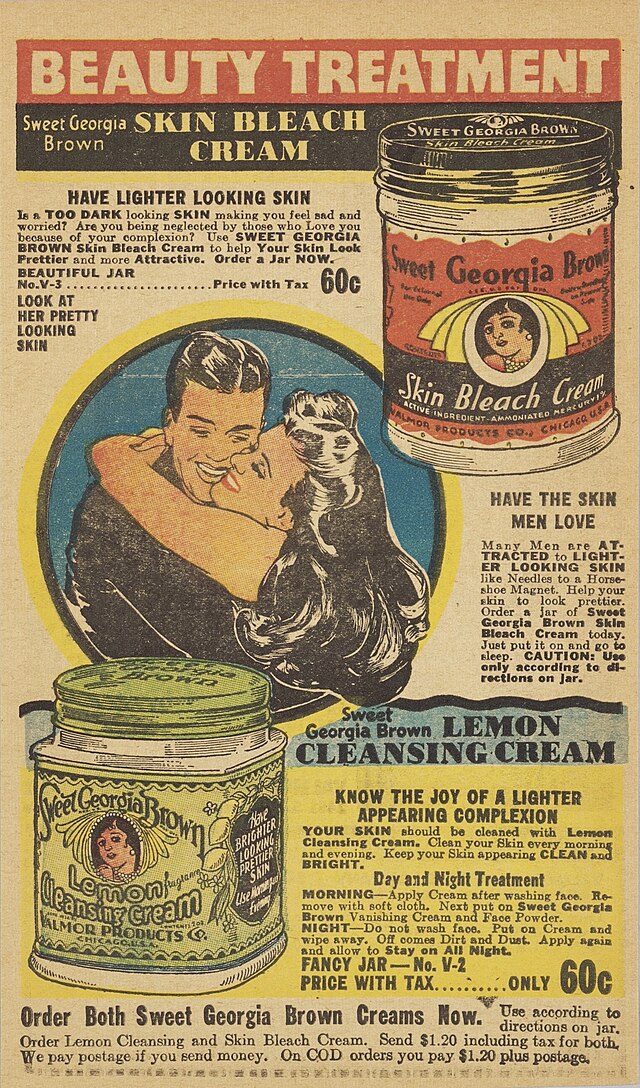
- Describe the people shown in the illustrations. What are they doing? What expressions do they have?
- What colours are used? What condition is the advertisement in, and what does this tell us about its age?
- How is the page laid out? What is placed at the top versus the bottom?
Text Analysis:
- The headline asks: “Is a TOO DARK looking SKIN making you feel sad and worried?” What assumption does this question make?
- Find the phrase “Have the skin men love.” Who is this product being sold to?
- The product contains “ammoniated mercury” (visible on the jar). Why might this detail be important? (Teacher note: mercury is now known to be highly toxic)
Connecting Image and Text:
- How do the illustrations support the written messages?
- What is being promised to someone who buys this product?
Stage 3: World Connections (20 minutes)
Understanding Context
Historical Context (Class Discussion):
This advertisement appeared in African American publications during the 1930s in the United States – a period of racial segregation known as “Jim Crow.”
Discuss as a class:
- Who created this advertisement and who was it aimed at?
- Why might a company target Black consumers with products promising lighter skin during this period?
- What does this advertisement tell us about the beauty standards that existed at the time? Who decided what “beautiful” meant?
Power and Profit:
The company selling this product was making money by:
- Exploiting insecurities created by racism
- Selling a “solution” to a “problem” that was actually social discrimination
- Using a toxic ingredient (mercury) that could harm users’ health
Discussion Questions:
- Who benefits from making people feel their natural appearance is wrong?
- The product name “Sweet Georgia Brown” references a popular jazz song. Why might using this name have been a deliberate choice?
Then and Now
In small groups, discuss:
- Do advertisements today ever make people feel they need to change their natural appearance? Can you think of examples?
- What’s the difference between choosing to change your appearance and feeling pressured to change it?
- How might social media continue some of the patterns we see in this historical advertisement?
Reflection Task
Individual written response (5 minutes):
Choose ONE of the following prompts:
- Write a short paragraph explaining what you think a teenager in the 1930s might have felt when seeing this advertisement, and what you felt looking at it today.
- If you could ask the people who made this advertisement one question, what would it be and why?
- What has analysing this advertisement taught you about how images can be used to influence how people feel about themselves?
Extension Activities
Creative Response: Design a counter-advertisement from the same period that challenges the messages in the original.
Research: Investigate the history of beauty standards in different cultures. Have ideas about beauty always been the same?
Media Literacy: Find a contemporary advertisement and analyse it using the same three-stage framework (Individual–Image–World). What messages is it sending about identity and belonging?
Teacher Notes
Sensitive Content Guidance: This advertisement contains explicitly colourist messages that may be painful for some students, particularly those with lived experience of colourism or racism. Consider your class composition and prepare to handle emotional responses with care. Emphasise that the values expressed in this advertisement are harmful and wrong, and that examining historical materials critically is different from endorsing them.
Key Concepts to Reinforce:
- Colourism existed (and exists) within as well as between racial communities
- Advertisements are designed to create desire—often by first creating insecurity
- Historical sources help us understand how discrimination operated in everyday life
- Critical analysis empowers us to recognise manipulation
Curriculum Links: This exercise supports learning about civil rights history, media literacy, and personal identity development. It connects to discussions about representation, power, and the ethics of advertising.
 Teach Critically
Leave a comment