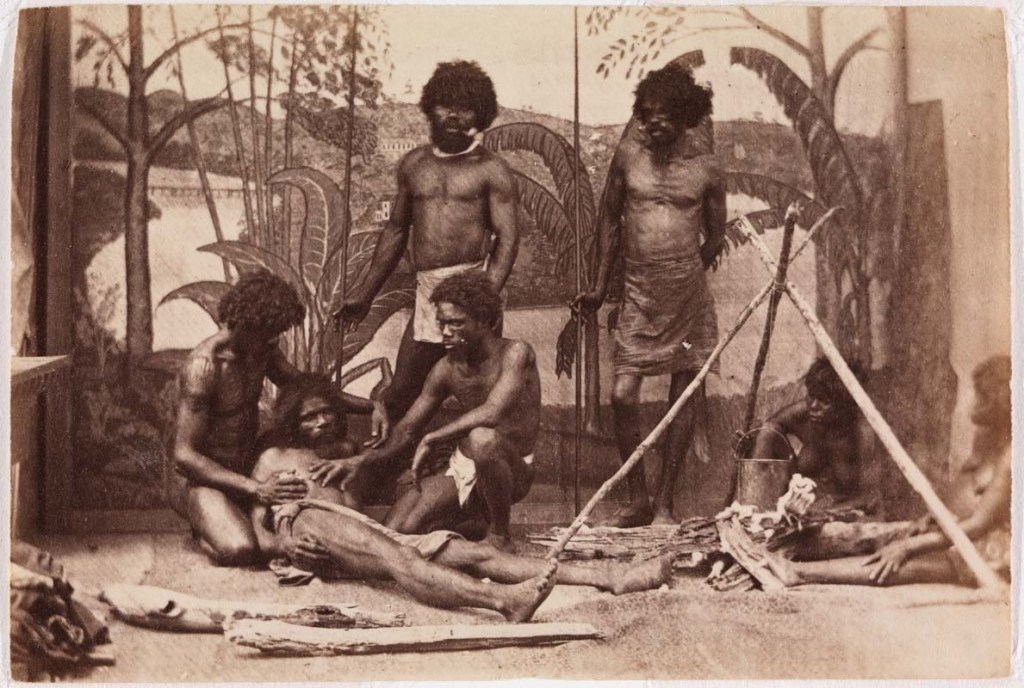
Level: A-Level / Year 12–13 (Ages 16–18) Time Required: 50–55 minutes Subject Links: History, Photography & Media Studies, Sociology, Post-Colonial Studies
Image Information
Artist: Daniel Scotland Marquis (b.1829, Scotland – d.1879, Australia)
Title: Studio portrait of Indigenous group
Date: c.1865
Medium: Gold-toned albumen photograph on paper
Dimensions: 6.1 × 9cm (irregular)
Collection: Queensland Art Gallery, Brisbane (Acc. 1994.056)
Description: A staged studio portrait of Indigenous Australian men photographed in front of a painted backdrop depicting Brisbane scenery. The subjects are arranged in a tableau with props including a tripod cooking frame and vessel, positioned on what appears to be studio flooring dressed with natural materials.
Learning Objectives
Students will critically examine how colonial photography constructed representations of Indigenous peoples, interrogate the concept of photographic “authenticity,” and situate this image within the violent context of 1860s Queensland frontier society.
Historical Context for Students
Queensland in the 1860s:
Queensland became a separate colony from New South Wales in 1859. The 1860s marked a period of rapid pastoral expansion into Indigenous lands, accompanied by systematic violence. The Queensland frontier was one of the most violent in Australian colonial history, with massacres, poisonings, and the deployment of the Native Police, a paramilitary force of Aboriginal troopers commanded by white officers, used to “disperse” Indigenous people from land wanted by settlers.
Photography and colonialism:
Photography arrived in Australia in the 1840s, coinciding with intensified colonial expansion. The new medium was understood as objective and scientific – it was seen as a way of documenting “truth.” Colonial photographers produced images of Indigenous peoples for scientific study, commercial sale, and circulation to audiences in Britain and Europe who would never encounter the subjects themselves. These photographs shaped how Indigenous Australians were understood, and misunderstood, globally.
Stage 1: Individual Response (10 minutes)
First Looking
Examine the photograph carefully before reading any contextual information.
Written responses:
Describe exactly what you see. What is in the frame? What details do you notice about the setting, the people, the objects, the composition?
What is your initial interpretation of this image? What story does it appear to tell?
Now read the title and context provided above. How does knowing this is a studio portrait with a painted backdrop change your reading of the image?
Reflection:
Roland Barthes argued that photography carries an implicit claim: “this has been”—it asserts that what appears in the frame really existed before the camera.
How does the staged nature of this image complicate that claim?
What has been in this photograph, and what has been fabricated?
Stage 2: Image Analysis (15 minutes)
Deconstructing the Scene
Working in pairs, conduct a systematic analysis of the image’s construction.
The Setting:
Describe the painted backdrop. What kind of landscape does it depict?
What is visible at the edges of the frame that reveals the studio context?
Why might a photographer choose to place Indigenous subjects in front of a painted backdrop rather than photographing them in an actual landscape?
The Subjects:
How are the men arranged? Consider composition, posture, grouping, and eye lines.
What are they wearing? What objects are included in the scene?
Who do you think decided how these men would be posed, dressed, and arranged? Whose vision does this image represent?
The Apparatus:
This is a gold-toned albumen print—a process requiring subjects to remain still for several seconds. What does the technical process demand of the people being photographed?
Consider the power dynamics of the studio. Who controls the camera, the props, the backdrop, the poses? Who cannot leave?
The Question of Consent and Context
We do not know:
The names of the men photographed
Whether they consented to be photographed
Whether they were paid, coerced, or otherwise brought to the studio
What they understood about how the image would be used
Discussion questions:
What does this absence of information tell us about whose perspective colonial archives preserve?
How should we approach images where the subjects had no control over their representation?
Stage 3: World Connections (20 minutes)
Colonial Violence and Visual Culture
The frontier context:
In the 1860s, Queensland was an active war zone. While Daniel Marquis operated his Brisbane studio, the Native Police were conducting operations across the colony that historians now recognise as genocidal. Between 1859 and 1897, an estimated 65,000 Aboriginal people were killed in Queensland through direct violence, and many more through introduced disease and dispossession.
Discussion questions:
This photograph presents Indigenous men in a controlled, aestheticised studio environment. What realities of 1860s Queensland does this staging obscure?
How might this image have functioned to reassure white colonial audiences? What story about colonisation does it implicitly tell?
The photograph was made for sale and circulation. Who was the intended audience? What were they being invited to see—and not see?
“Authenticity” and Manufactured Evidence
The constructed “primitive”:
Colonial photographers frequently staged images that purported to show Indigenous people in their “natural” state—while actually constructing that state through props, backdrops, costumes, and poses chosen by the photographer.
Discussion questions:
What ideas about Indigenous Australians does this staging communicate? What assumptions underpin the visual choices?
The painted backdrop depicts a recognisable Brisbane landscape, yet the subjects are presented as existing somehow outside or before colonial society. What ideological work does this contradiction perform?
Photographs like this were used as anthropological and scientific evidence. What are the implications of treating manufactured images as documentary truth?
Individual written response:
Choose ONE prompt:
“The camera does not simply record reality; it produces it.” Using this image as your primary evidence, evaluate this claim in relation to colonial photography.
We know the photographer’s name but not the names of the men he photographed. Write a reflection on what this asymmetry reveals about colonial archives and the politics of historical memory.
Consider the ethics of displaying and studying this image today. What obligations do we have to the subjects? How should institutions approach such materials?
Extension Activities
Comparative analysis: Research other colonial studio photographs of Indigenous peoples from the same period (Australian, North American, African contexts). What visual conventions recur? How was the “primitive” constructed across different colonial settings?
Archival research: Investigate the Native Police and frontier violence in 1860s Queensland. How does this historical context reshape your reading of seemingly “peaceful” colonial images?
Contemporary responses: Research how Indigenous Australian artists have engaged with, responded to, or reclaimed colonial photographic archives. Consider works by artists such as Christian Thompson, Brook Andrew, or Leah King-Smith.
Tutor Notes
Sensitivity and Positioning:
This image depicts Indigenous Australian people in a context shaped by colonial violence. Some students may be Indigenous or have personal connections to these histories. The image should be approached with appropriate gravity, avoiding both sensationalism and detachment.
Emphasise that critical analysis of colonial representations is not about condemning historical individuals but understanding systems of power, knowledge production, and visual culture that shaped, and continue to shape, how Indigenous peoples are seen.
Assessment Connections:
This exercise develops skills in visual analysis, historical contextualisation, and engagement with post-colonial theory—applicable to A-Level History source analysis, Media Studies ideological critique, and Sociology examinations of power and representation.
______________________________________________________________________
Image Attribution and Copyright Information
Collection Record:
MARQUIS, Daniel Scotland/Australia b.1829 d.1879 (Studio portrait of Indigenous group) c.1865 Gold-toned albumen photograph on paper 6.1 x 9cm (irreg.) 6.1 x 9cm (irreg., comp.) Queensland Art Gallery Collection Acc. 1994.056
Public Domain Status:
This work is in the public domain in its country of origin and other countries and areas where the copyright term is the author’s life plus 70 years or fewer.
United States Public Domain Tag:
This work is in the public domain in the United States because it was published (or registered with the U.S. Copyright Office) before January 1, 1930.
Note on Extended Copyright Terms:
A few countries have copyright terms longer than 70 years: Mexico has 100 years, Jamaica has 95 years, Colombia has 80 years, and Guatemala and Samoa have 75 years. This image may not be in the public domain in these countries, which moreover do not implement the rule of the shorter term. Honduras has a general copyright term of 75 years, but it does implement the rule of the shorter term. Copyright may extend on works created by French people who died for France in World War II (more information), Russians who served in the Eastern Front of World War II (known as the Great Patriotic War in Russia) and posthumously rehabilitated victims of Soviet repressions (more information).
 Teach Critically
Leave a comment