Level: Undergraduate (Level 4) Time Required: 45 minutes Subject Links: Media Studies, Gender Studies, Cultural Studies, Visual Culture, Sociology
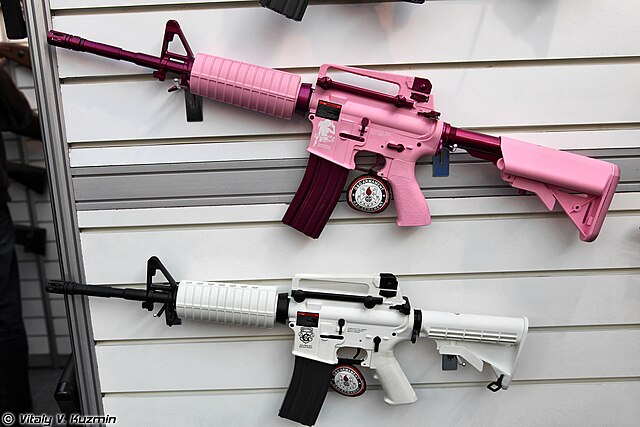
Image Credit: Vitaly V. Kuzmin, Russian photojournalist. Photograph taken at an international arms trade fair, 2012.
Learning Objectives
Students will critically analyse how the firearms industry employs gendered aesthetics and the semiotics of “cuteness” to expand markets, normalise weapon ownership, and resolve ideological tensions between femininity and violence.
Theoretical Framework
This exercise draws on:
- Commodity feminism (Goldman, 1992) — the appropriation of feminist discourse for commercial purposes
- Cute aesthetics and power (Ngai, 2012) — how cuteness operates as an aesthetic category that disarms critique
- Gender performativity (Butler, 1990) — how products invite consumers to perform gendered identities
- Material culture studies — how objects carry and communicate meaning
Stage 1: Individual Response (8 minutes)
Defamiliarisation
Before any contextual information, students spend three minutes in silent observation.
Written responses:
The philosopher Roland Barthes distinguished between studium (cultural, linguistic, political interpretation) and punctum (the detail that pierces or disturbs the viewer).
- What is the studium of this image—what does it straightforwardly communicate?
- Is there a punctum—something that catches, pricks, or unsettles you? Describe it.
Theoretical connection:
Sianne Ngai argues that cuteness is an aesthetic response to things that appear soft, small, and unthreatening—things we want to touch, squeeze, or possess.
- How does this image mobilise or complicate the “cute” aesthetic?
- What is your affective response, and how does it sit alongside your intellectual response?
Stage 2: Image Analysis (15 minutes)
Semiotic Deconstruction
Working in pairs, students conduct a systematic visual analysis.
Colour Semiotics:
The weapons are finished in pink (with magenta accents) and white.
- What cultural associations do these colours carry? Consider gender, childhood, innocence, domesticity.
- Pink became gendered female in Western markets primarily after WWII. How does this historical contingency complicate “natural” associations between colour and gender?
- How does the colour palette interact with the form of the object—an AR-15 style rifle, a weapon designed for military combat?
Context of Display:
This photograph was taken at an arms trade fair—a commercial environment where weapons are marketed to buyers.
- What does the retail display context (slatwall merchandising, commercial photography) tell us about the intended function of these objects?
- How does displaying weapons like consumer goods work to normalise them?
Iconographic Details:
Examine any logos, emblems, or decorative elements visible on the weapons.
- What visual vocabulary is being employed?
- How do these details contribute to or complicate the gendered messaging?
The Semiotic Contradiction
Core tension: These are lethal weapons aestheticised through codes of femininity, childhood, and harmlessness.
- Judith Butler argues gender is performative—something we do rather than something we are. How do these products invite a performance of gender? What kind of femininity is being constructed?
- What ideological work does the “cute” aesthetic perform? What does it obscure, permit, or make palatable?
Stage 3: World Connections (17 minutes)
Market Contexts
The gendering of firearms markets:
The US firearms industry has explicitly pursued female consumers as a growth demographic, particularly since the 2000s. Marketing campaigns have emphasised personal protection, empowerment, and aesthetic customisation.
Discussion questions:
- What economic logic drives the production of pink firearms? Who benefits from expanding the market in this direction?
- How does this marketing appropriate feminist language (empowerment, choice, self-determination) while selling products designed to kill?
- Consider the phrase “commodity feminism.” How does this image exemplify or complicate that concept?
The weaponisation of cuteness:
Ngai argues that cute objects invite domination as we want to squeeze, pinch, possess them. Cuteness is powerlessness and imbues the viewer with a desire to protect, control and/or consume the cute.
Discussion questions:
- What happens when cuteness is applied to an object whose purpose is to project lethal power?
- Does the cute aesthetic domesticate the weapon, making it seem safe and controllable? Or does it create an uncanny dissonance?
- Who is the implied consumer of these products? What assumptions does the manufacturer make about what women want?
Cross-cultural perspectives:
The photographer, Vitaly V. Kuzmin, is Russian, documenting an international arms trade fair. These weapons reflect primarily American market logics.
- How might this image read differently in contexts with different relationships to gun ownership, gender, and consumer culture?
- What does it mean that weapons are marketed with the same techniques used to sell handbags, phones, or kitchen appliances?
Broader Implications
Violence and aesthetics:
- Susan Sontag wrote about the “aestheticisation of violence.” How does this image participate in that process?
- Does making a weapon “beautiful” or “cute” change our ethical relationship to it?
Children, gender, and harm:
Pink is strongly associated with girlhood in contemporary Western markets.
- What are the implications of aestheticising weapons through codes associated with children?
- How does this connect to broader debates about the boundaries between childhood and violence?
Reflection and Synthesis (5 minutes)
Individual written response:
Choose ONE prompt:
- “Cuteness disarms critique.” Using this image as your primary evidence, evaluate Ngai’s claim about the political function of cute aesthetics.
- Analyse the semiotic contradiction at the heart of this image. How does the tension between form (lethal weapon) and aesthetic (feminised cuteness) produce meaning—and for whom?
- Consider this image as evidence of commodity feminism in action. What is being sold alongside the physical product, and what ideological work does the purchase perform?
Further Reading and Research
Theoretical texts:
- Ngai, Sianne. Our Aesthetic Categories: Zany, Cute, Interesting (2012), especially Chapter 1 on cuteness
- Goldman, Robert. Reading Ads Socially (1992) on commodity feminism
- Butler, Judith. Gender Trouble (1990) on performativity
Contextual research:
- Carlson, Jennifer. Citizen-Protectors: The Everyday Politics of Guns in an Age of Decline (2015)
- Browder, Laura. Her Best Shot: Women and Guns in America (2006)
- Trade publications such as Women & Guns magazine and NSSF (National Shooting Sports Foundation) market research
Visual comparisons:
- Military “kawaii” aesthetics in Japanese Self-Defence Force recruitment
Seminar Discussion Questions
For follow-up discussion or essay development:
- How does the firearms industry’s pursuit of female consumers compare to other historically male-dominated industries (motorcycles, gaming, craft beer)? What patterns emerge?
- Ngai identifies cuteness as an aesthetic of powerlessness. How does applying cute aesthetics to a weapon—an object that confers lethal power—create ideological contradiction? Is this contradiction productive for the seller?
- Consider the image’s circulation: taken by a Russian photojournalist at an international trade fair, now viewed in a British university classroom. How does context shape meaning? What does this image do differently in each setting?
- If gender is performative, what performance do these products enable or invite? What kind of subject is being hailed by this marketing?
Tutor Notes
Positioning:
This exercise does not require students to adopt a particular political position on firearms legislation. The analytical focus is on how meaning is constructed through visual and material culture, and what ideological work gendered aesthetics perform in commercial contexts. Students from various political backgrounds should be able to engage with semiotic and cultural analysis.
Sensitivity:
Students may have personal experiences with gun violence, either directly or through media exposure to mass shootings. The image may provoke strong responses. Frame discussion around critical analysis of marketing and visual culture rather than debate about gun policy per se.
Assessment connections:
This exercise supports development of skills in visual analysis, application of cultural theory, and ideological critique; skills transferable to analysis of any gendered product marketing or aesthetic commodification.
 Teach Critically
Leave a comment