Target Age Group: 14–16 years old (Key Stage 4 / GCSE) Time Required: 50–55 minutes Subject Links: History, Religious Studies, Media Studies, French, Politics
Learning Objectives
Students will analyse a First World War propaganda postcard to understand how images combined nationalism, religion, and gender to build support for war, and consider how mass-produced visual culture shaped public feeling during conflict.
Context for Teachers
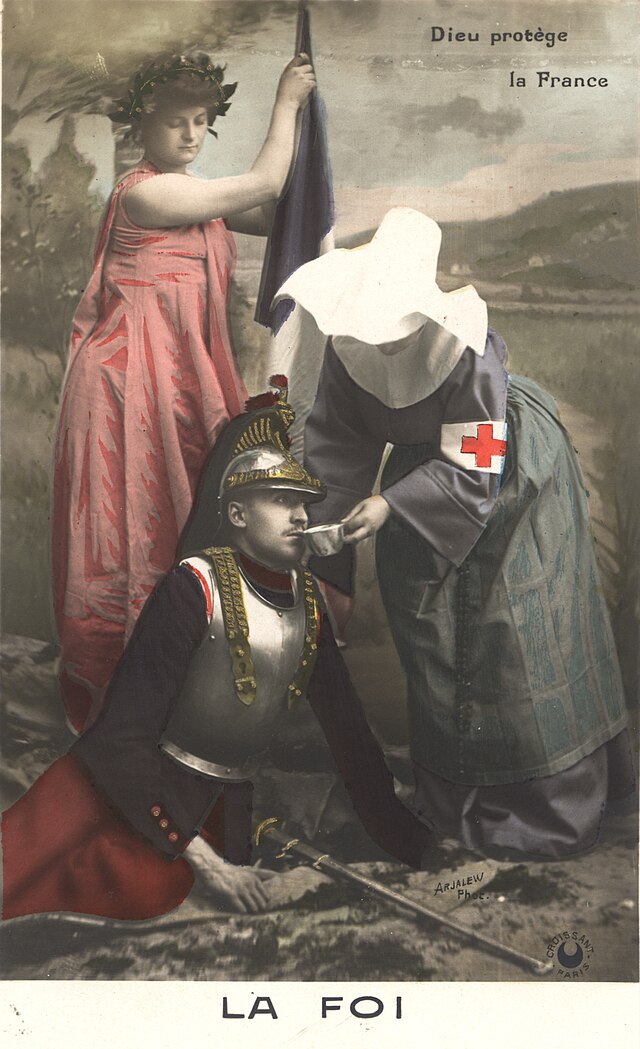
This hand-tinted French postcard dates from the First World War (1914–1918). Postcards were a major form of communication and propaganda during this period—cheap to produce, easy to send, and widely collected. They circulated in their millions, shaping how civilians understood the war and their role in supporting it.
The French text reads:
- “Dieu protège la France” — “God protects France”
- “La Foi” — “Faith”
Stage 1: Individual Response (10 minutes)
First Impressions
Students examine the postcard independently before any discussion.
Observation task: Look at this image for two full minutes without writing anything. Notice where your eyes travel. What draws your attention first, second, third?
Then respond in writing:
- Describe the mood or atmosphere of this image in one sentence.
- This image makes me think of… (complete freely)
- What questions does this image raise for you?
Private reflection: Does this image feel like it’s showing something “real” or something constructed? What gives you that impression?
Stage 2: Image Analysis (20 minutes)
Identifying the Figures
Working in pairs, students identify and analyse each figure in the composition.
Figure 1: The Woman in Pink
- Describe her clothing, pose, and what she holds.
- She wears a laurel wreath—a symbol associated with victory since ancient Greece and Rome. What does this suggest about her identity?
- This figure represents Marianne, the female personification of the French Republic. Why might a nation be represented as a woman?
Figure 2: The Soldier
- Describe his uniform and equipment in detail. Note the breastplate and plumed helmet—this is a cuirassier, a type of cavalry soldier.
- What is his physical position? What does his posture communicate?
- Why might the image-makers have chosen this older, more ornate uniform style rather than the reality of trench warfare?
Figure 3: The Nurse
- Describe her clothing, including the distinctive headdress (a cornette, associated with Catholic nursing sisters).
- Her face is hidden. Why might this be a deliberate choice?
- What action is she performing, and what does this suggest about women’s roles?
Reading the Composition
Spatial arrangement:
- Draw a quick sketch showing where each figure is positioned. Who is highest? Lowest? In the centre?
- What does this vertical arrangement suggest about the relationship between these three figures?
The text:
- “Dieu protège la France” and “La Foi” appear on the postcard. How do these words change how we read the image?
- Is this a religious image, a patriotic image, or both? Can you separate them?
Stage 3: World Connections (20 minutes)
Historical Context
The Postcard as Mass Medium:
During WWI, millions of postcards circulated between soldiers and civilians. They were:
- Cheap and accessible
- Subject to censorship (nothing critical of the war effort)
- Collected in albums as keepsakes
- A way for governments and businesses to spread messages
Discussion questions:
- Who might have sent this postcard, and to whom?
- What purpose does an image like this serve during wartime?
- How is this different from a photograph of actual battlefield conditions?
Unpacking the Messages
Religion and Nationalism:
The postcard explicitly claims divine protection for France. During WWI, all major combatant nations claimed God was on their side.
- What does it mean to suggest that God has chosen one nation over others in war?
- How might this message have comforted—or pressured—people at home?
- German belt buckles were inscribed “Gott mit uns” (God with us). What does it tell us that both sides made the same claim?
Gender Roles:
This image presents three distinct roles: the symbolic feminine nation, the masculine warrior, and the caring nurse.
- What is each figure’s relationship to violence? Who fights, who inspires, who heals?
- The nurse’s face is hidden while Marianne’s is visible. What might this suggest about how these two types of femininity were valued?
- How does this image define what men and women should do in wartime?
Reality versus Representation:
The cuirassier uniform shown was already outdated by 1914—cavalry charges proved disastrous against machine guns and artillery.
- Why might propagandists show war in this romanticised way rather than depicting trenches, mud, and mass casualties?
- Who benefits from this version of war?
Then and Now
In small groups:
- Can you think of modern examples where national symbols, religious language, and images of sacrifice are combined? (Consider remembrance ceremonies, political campaigns, charity appeals)
- What is the modern equivalent of the propaganda postcard? How do images circulate today to shape feelings about conflicts?
Reflection Task
Individual written response (5 minutes):
Choose ONE prompt:
- A French soldier in a trench receives this postcard from his family. What might he think or feel, given what he knows about the reality of the war?
- The postcard claims “God protects France.” Write a paragraph exploring what this claim reveals about how religion was used during the First World War.
- This postcard presents a version of war with no blood, no trenches, and no death. Why do you think people at home might have wanted—or needed—to believe in this version?
Teacher Notes
Key Historical Concepts:
- Propaganda and its techniques
- The gap between war as represented and war as experienced
- Civil religion and the fusion of national and religious identity
- Gender and total war
Sensitive Content Guidance: This image romanticises warfare. Students may have family histories connected to military service or conflict. Frame discussion around critical analysis of propaganda techniques rather than judgements about individual soldiers or their families.
Discussion Management: The religion component may provoke strong responses from students with various faith backgrounds or none. Emphasise that the learning objective is to understand how religious language was used during this period, not to evaluate religious beliefs themselves.
Curriculum Links: This exercise supports GCSE History units on WWI, causes of conflict, and propaganda. It also connects to Religious Studies discussions of religion and politics, and Media Studies analysis of visual persuasion.
Language Support: For mixed classes, the French text provides an opportunity for cross-curricular work. “La Foi” meaning “Faith” and “Dieu protège la France” meaning “God protects France” are accessible starting points for students with any level of French.
 Teach Critically
Leave a comment