Exercise Title: Shields and Authority: The Visual Language of Militarized Policing
For students aged: 16-18
Time required: 60 minutes
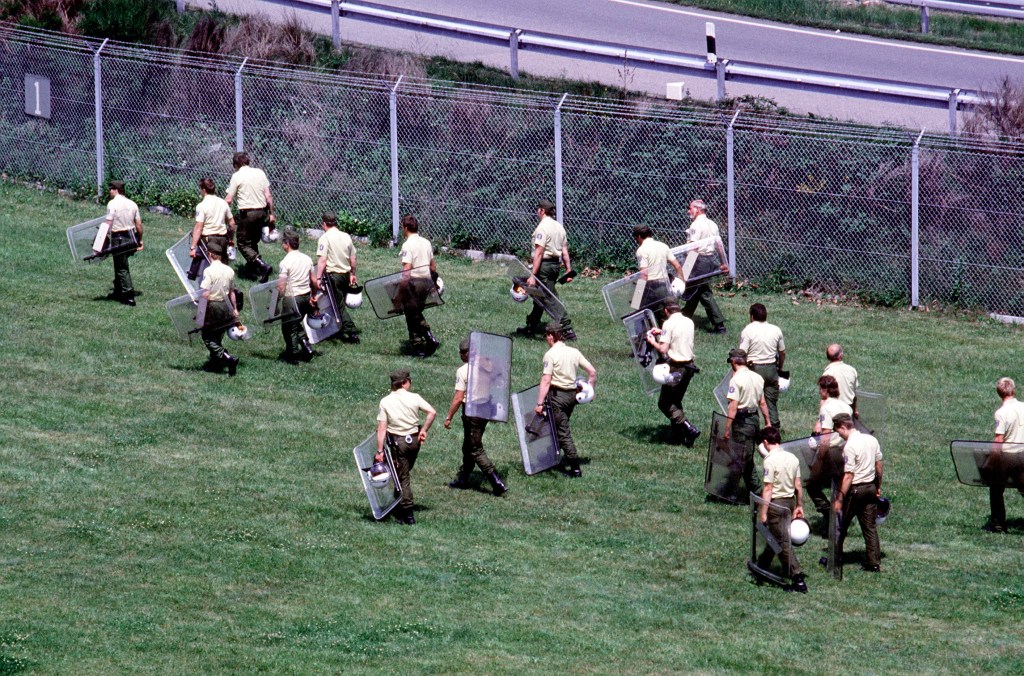
Image Context: This photograph from 1986 shows West German police in riot gear during a training exercise or formation. The 1980s in West Germany saw significant social movements, including anti-nuclear protests, squatter movements, and demonstrations against NATO missile deployments, leading to increased investment in riot control capabilities by police forces.
Learning Objectives:
- Analyze the visual rhetoric of militarized policing
- Understand the historical context of police militarization in 1980s Germany
- Critically examine the relationship between state power, protest, and social control
- Connect historical patterns to contemporary debates about policing tactics
Materials Needed:
- The 1986 German police photograph
- Paper/notebooks
- Optional: images of contemporary riot police for comparison
- 60 minutes – 1 hour
Part 1: Visual Analysis (10 minutes)
Examine the photograph silently for 90 seconds.
Individual written response:
- Describe what you see in detail: formation, equipment, body language, setting
- What words come to mind when you look at this image?
- If you were a protestor in 1986 and saw this formation approaching, how would you feel?
- If you were a police officer in this formation, how might you feel?
Note the contradictions: Militarized equipment on a peaceful grass field. Riot shields, but no riot. What does practicing for confrontation communicate about expectations?
Part 2: Historical Context – West Germany in the 1980s (10 minutes)
Teacher-led information with discussion:
Political Climate of 1980s West Germany:
- Cold War tensions at their height—divided Germany, Berlin Wall, NATO vs Warsaw Pact
- Mass anti-nuclear movement (protests against nuclear power and weapons reached millions)
- Squatter movements in cities like Berlin and Hamburg challenging local housing policies
- Environmental activism (Green Party founded 1980)
- Autonome movement—radical leftist protestors who sometimes engaged in property destruction
- Red Army Faction (RAF) terrorism still active, creating security anxieties
- Memory of 1960s-70s student movements and violent state responses
Police Response:
- Increased investment in riot control equipment and tactics
- Development of specialized units (Bereitschaftspolizei)
- Adoption of military-style formations and equipment
- Controversial tactics including kettling, water cannons, and aggressive dispersal
Key Incidents:
- 1981: Brokdorf nuclear plant protests (massive police operation)
- 1986: Chernobyl disaster intensifies anti-nuclear sentiment
- 1987: Death of protestors at Wackersdorf nuclear facility heightens tensions
Class Discussion:
- Why might democratic governments feel they need militarized police?
- How does the presence of military-style equipment change the nature of protest?
- What’s the difference between “keeping the peace” and “controlling dissent”?
Part 3: Reading the Image – Visual Rhetoric of Force (20 minutes)
Small group analysis (3-4 students):
Examine how this image communicates state power:
Equipment and Uniformity:
- Riot shields
- Helmets with visors: What does hiding faces do? (dehumanization, anonymity, intimidation)
- Batons visible at sides
- Matching uniforms: creating a unified “force” rather than individual officers
- How does this differ from a traditional police officer’s appearance?
Formation and Tactics:
- Officers arranged in lines and clusters: military formation
- Shields creating literal barriers between police and citizens
The Setting:
- Peaceful grass, suburban background, ordinary setting
- The normalcy of the surroundings contrasts with the military preparation
- This could be any public space. What does that communicate?
Critical Questions:
- Does the equipment create the threat, or respond to it?
- When does “being prepared” become “being provocative”?
- What changes when police look like soldiers?
Part 4: Closing Discussion (20 minutes)
Individual reflection – choose prompts to write on:
Rights and Power:
- Do you think that the presence of riot police makes protests safer or more dangerous? Why?
- How does the visual threat of force affect willingness to exercise democratic rights?
- What’s the relationship between freedom of assembly and state power?
Systemic Questions:
- Who benefits from militarized policing? Who is harmed?
- What alternatives exist to confrontational policing of protests?
- Do you think it’s possible to have both effective security AND full democratic freedoms?
 Teach Critically
Leave a comment