Exercise Title: A Daily Ration: Survival, Scarcity, and the Value of Food
For students aged: 15-16
Time required: 45 minutes
Exercise Title: A Daily Ration: Survival, Scarcity, and the Value of Food
For students aged: 15-16
Time required: 45 minutes
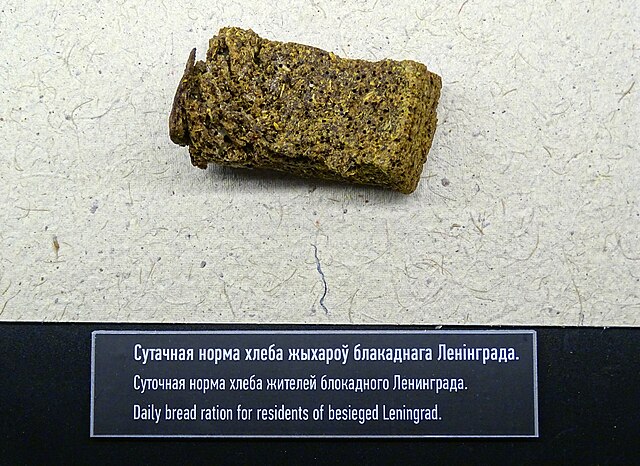
Image Context: This museum exhibit shows the daily bread ration for residents of Leningrad (now St. Petersburg) during the Nazi siege of 1941-1944. This small piece of bread was often all a civilian had to eat for an entire day. Over 1 million people died during the 872-day siege, most from starvation.
Learning Objectives:
- Understand the human cost of war beyond battlefield casualties
- Analyze how museums represent trauma and historical suffering
- Critically examine relationships between conflict, resources, and power
- Reflect on contemporary food consumption and waste in contrast to historical scarcity
Content Warning: This lesson addresses mass starvation, siege warfare, and civilian death. Create space for sensitive discussions and allow students to step out if needed.
Materials Needed:
- The museum exhibit image
- Paper/notebooks
- Optional: a slice of bread for physical comparison
- 45 minutes
Part 1: Visual Impact (7 minutes)
Look at the image in silence for one full minute.
Individual written response:
- Describe this object in detail. What do you notice about its size, texture, color?
- How does seeing this object in a museum case affect you?
- What’s your immediate emotional response?
- If this were your only food for a day, what would that feel like?
Part 2: Historical Context – The Siege of Leningrad (10 minutes)
Teacher-led information sharing:
The Siege (1941-1944):
- Nazi Germany surrounded Leningrad for 872 days, cutting off all supply routes
- Hitler’s plan was deliberate starvation in order to eliminate the city’s population
- Over 1 million civilians died, mostly from hunger and cold
- People burned furniture for heat, ate wallpaper paste, leather belts, anything
- The city never surrendered
The Bread:
- At the worst point, this ration was reduced further for civilians
- Workers received slightly more as they were essential for defense
- The “bread” contained sawdust, cellulose, and other non-food materials to stretch the supplies
Class Discussion:
- Why might this piece of bread be preserved in a museum?
Part 3: Reading the Museum Display (12 minutes)
Small group analysis (3-4 students):
Examine how this exhibit presents history:
Display Choices:
- The bread is isolated on a clean white surface under glass. How does displaying it like a precious artifact change its meaning?
- The label is in three languages. Who is the intended audience?
- What’s the effect of seeing the actual object versus reading a text about starvation?
What’s Present and Absent:
- This exhibit shows one piece of bread. What does it NOT show? (bodies, suffering, context, individual stories)
- Is this more or less powerful than showing graphic images of starvation?
Whose History:
- This is in the “Great Patriotic War” museum in Belarus. What does this name tell us? (Soviet perspective, national pride in resistance)
- Why does Belarus preserve Leningrad’s history in their museum?
Critical Questions:
- Can an object like this truly communicate the experience of starvation?
- What’s the purpose of preserving objects of suffering?
- Who benefits from remembering this history?
Part 4: Conflict, Resources, and Power (10 minutes)
Whole class discussion:
Historical Patterns:
- Controlling food has always been a weapon of war. Why is it so effective?
- Throughout history, who decides who eats and who doesn’t? (Think: sieges, famines, blockades, sanctions)
Contemporary Connections:
- Starvation as a weapon is now considered a war crime. Yet where does it still happen?
- Modern conflicts often target food systems: destroying crops, blocking aid, controlling water
- Why does the international community struggle to prevent starvation in conflict zones?
Food and Power Today:
- Who controls global food supply chains?
- What happens when food becomes scarce or expensive? Who suffers most?
Part 5: Consumption and Waste (6 minutes)
Individual reflection – choose one or more prompts:
Personal Consumption:
- When did you last think about whether you’d have enough food?
Cultural Patterns:
- In the UK, we waste approximately 9.5 million tonnes of food annually, with bread being one of the most wasted items
- Globally, about one-third of food produced is wasted, while 735 million people face hunger
- What systems create this inequality?
- Does knowing about historical and contemporary instances of starvation change how we should think about waste?
Critical Questions:
- What would it mean to you to truly value food based on this history?
- Are individual choices (not wasting food) enough, or are systemic changes needed?
 Teach Critically
Leave a comment